Methodist High School, Ilesa: The Onaeko Years
When Methodist High School Ilesa was founded in 1956, the school had the fortune of a committed, disciplined and strict disciplinarian as its first principal. Mr Onaeko, a graduate of Fourah Bay College Sierra Leone. He was on the staff of Wesley College Ibadan when he got deployed to Methodist High School Ilesa. He gave nobody any doubt as to his preparedness to nurse a new secondary school-particularly one that was mixed i.e consisting of female and male pupils, a very uncommon thing in those days. Apart from Remo Secondary School Shagamu which the Methodist Church Nigeria had earlier cofounded there was no other mixed secondary school in the whole of the old Western Region which stretched from the bulk of what is now Lagos state to Asaba on the bank of River Niger. This was to show the delicate responsibility that the first principal and his staff were saddled with.
Mr Onaeko carried this responsibility for the first seven years of the life of the school, a responsibility which he undoubtedly discharged with distinction.
Infrastructure
The school started with a single building consisting of 4 classrooms and an assembly hall. The first set on intakes consisted of 60 pupils divided into 2 arms- Form 1A and Form 1B. These pioneering students were to bear the brunt of the early physical transformation of the school compound. When the school started in 1956 it was preceded to that general environment by Methodist Girls School, another baby of the Methodist Church Nigerian. Methodist High School had a neighbour which was sharing the large expanse of Methodist Church land with it. The boundary between the two schools was a stretch of the historical ditch dug around Ilesa during the Yoruba Internecine wars. A narrow part of the ditch was filled to allow communication and contact between these two sister schools.
A sizeable number of the first intakes and subsequent ones were from out of town and this raised an issue of providing accommodation for them. Before the school took off an arrangement had been concluded with Methodist Girls School to accommodate the female students who would be boarders while a rented premises at Isokun precisely at 0.1, Ishokun. Ilesa was to accommodate the male pupils. Indeed the premises served a dual purpose as it also provided accommodation for Mr Onaeko and for Mr Obafemi Ohayeye who was the House Master. In succeeding years, the male boarders were still living in town hence the school had to acquire another rented house as an annex to 01, Isokun Street specifically 052 on the same Isokun street; the annex was much nearer to the school than the main boarding house at 01. Just as in 01 Isokun street, a new graduate teacher was housed on the first floor of 0.52 while a male non-graduate teacher was on the ground floor doubling as House Master. This was the arrangement for the boarders until around 1961 or so when a hostel for female students was built on the school premises II. In 1957, the second set of 30 pupils of whom I was priviledged to be one were admitted. A reduction in the number of intakes compared with the first set arose from the lack of another graduate teacher in addition to the school principal. As a matter of fact, the first set which still had two streams in 1957 was reduced to one stream thus pruning down the number of pupils to about 30 when the set resumed in Form 3 in 1958. So in that event, the first two sets and the succeeding sets were pegged at one stream each for most of the sets during the Onaeko years – 1956-1962.
The second building of the school was completed and declared open about 1958. It was an academic block consisting of a number of classrooms, the principal’s office and a staff room. Other physical structures which were added during the first seven years included the Vice- Principal’s quarters where the expatriate teacher-Miss Osborne was housed. Just before the second set finished in 1962, an assembly hall was added to the infrastructure of the school. As a matter of fact it was in that hall that a valedictory ceremony was held for the second set in December 1962 which also coincided with Mr Onaeko’s departure to Remo Secondary School Sagamu to become its new principal. In later years the school inherited the adjacent land and buildings occupied by Methodist Girls School following its scrapping.
Academics
Right from the inception of the school academics was accorded top priority. The teachers showed total commitment to their duties. They were strict and they insisted on high standard. Those of us pupils in those years realized in later years how much effort our teachers put into imparting knowledge; most of them had either Cambridge School Certificate or its equivalent or Grade li Teachers certificate. Only a few of them were pivotal teachers i.e combining Cambridge School certificate with Grade II Teachers certificate. As a matter of fact those of us in upper classes in 1961 and 1962 came to realize that some of our teachers were still struggling to pass the General Certificate Examination (Advanced Level) to qualify them to gain admission to a University. They were great teachers indeed. I could list most of them by names but in order to obviate the possibility of failed memory, I would avoid doing that but I cannot but mention the first three graduate teachers who joined the school during the first seven years. Miss Osborne from the United Kingdom who I had mentioned earlier, Mr Fajana and Mr Oloyede. Incidentally all these four, including the principal were arts graduates. During these first seven years of the school, the pupils did not have the opportunity of exposure to science subjects; the nearest to the sciences was Mathematics and Health Science, the latter being an alternative to the former for students who did not offer Mathematics in their penultimate and final years in school.
Sports and Extracurricular Activities
The pupils during this period had access to some indoor games particularly table tennis at which the school achieved a good reputation. A football field was constructed in front of the new academics block while the Netball field was located at the front of the main building. Adjacent to the netball field was a tenniquort court. The school engaged in football and netball competitions with schools in the surrounding areas up to Ipetu Ijesa and Osogbo and of course Ilesa itself.
It was not until 1962, after a sports field had being constructed directly behind the academic block that the school had its first inter-house competition Earlier ¡n that year, the school was divided into four Houses: Salako, Esan, Ogunmokun and Onaeko.
The first two Houses were named after a previous and the current Superintendent Methodist Church district respectively Ogunmokun House was named after the then reigning Owa Obokun, Oba Biladu 111 while the fourth House was named after the principal—-Mr EA. Onaeko. Expectedly, the first inter house competition was not only colourful and highly competitive but well attended by dignitaries and other secondary schools around. Onaeko House came out victorious; what a befitting ending and coincidental show of appreciation to an indefatigable foundation principal.
A lot of the physical development of the grounds of the school was due to the manual effort of the pupils. In those days most of the punishment meted out to erring or disobedient male students included the felling of trees, including palm trees, cutting of the bush or the construction of flower beds. In addition to these, every Friday afternoon, the principal instituted what he described then as “Mass Attack” which was the whole school coming out for all kinds of manual labour. By the end of the seventh year, the school was gradually taking shape. Its offices, classes and the entire premises were Permanently spick and spam.
Without a doubt, these seven years were the foundation years of the school and an enduring tribute to the pioneer principal, staff and the pupils.
Yemi Kayode-Adedeji
1962 Set
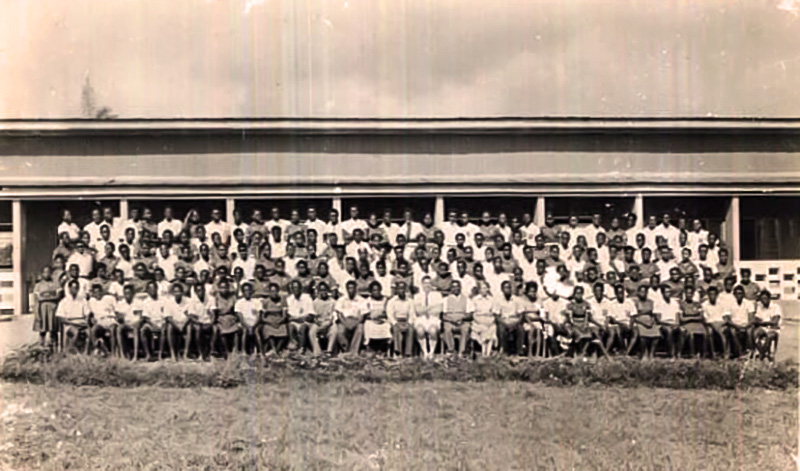
Entire school
The entire school – staff and pupils, in December 1962.
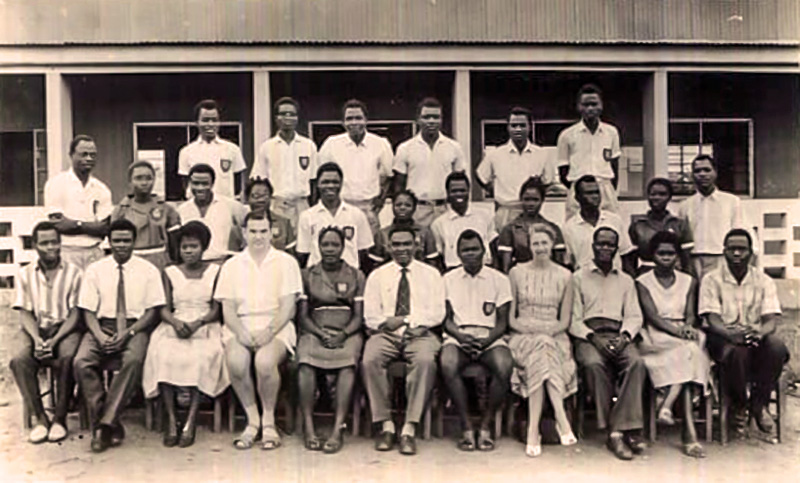
Staff and form six
The staff and the form six school certificate class finalists in December 1962.
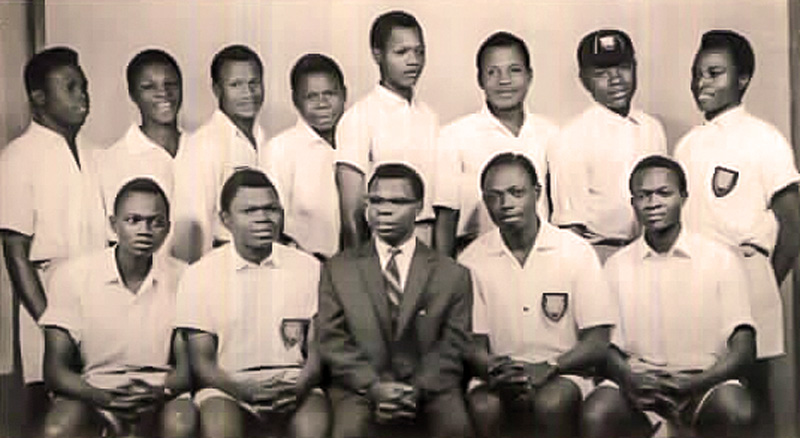
Final year male pupils
Final year male pupils with Mr Olarewaju in a send forth photograph to mark his return to University of Ibadan after his long vacation stint as Mathematics teacher – September 1962.
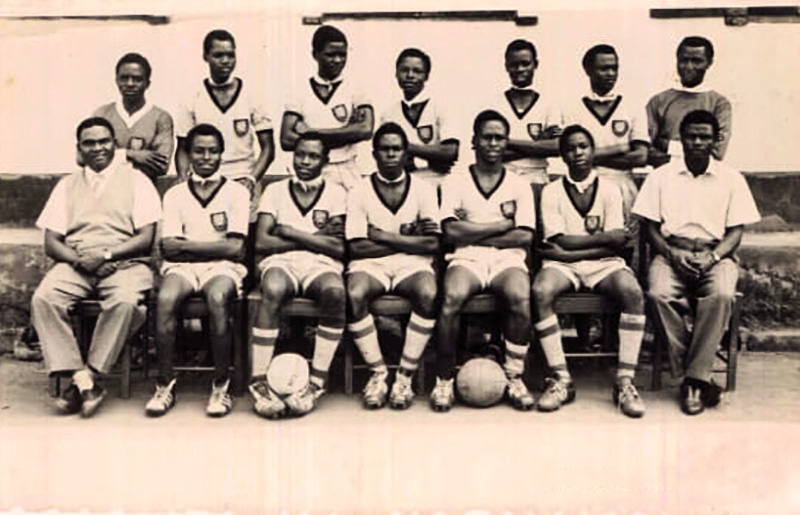
Football team in 1962
The principal, seated first from left, and the games master- Mr Adesegun, seated first from right, with the school Football team in 1962.
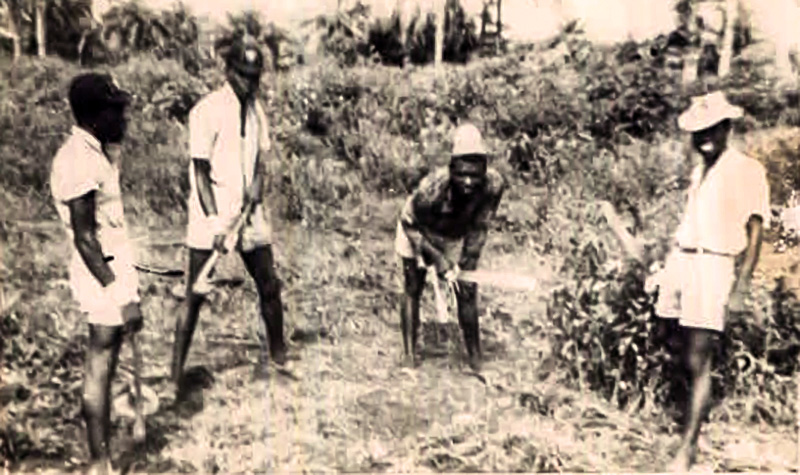
Serving punishment
Four final year pupils serving punishment for disobedience one week before and during WAEC examinations in 1962.